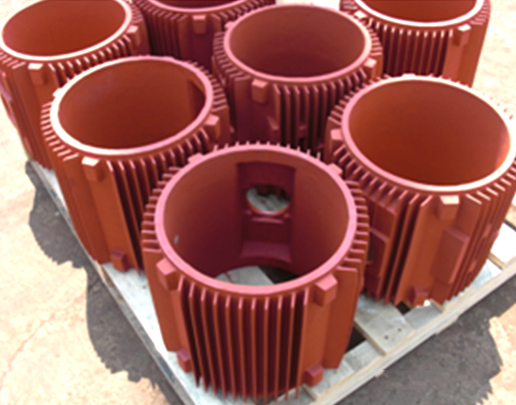
The surface treatment technology of Dalian motor casing is an important link to ensure motor performance, extend service life, and improve appearance quality. The motor casing is usually made of metal materials such as aluminum alloy, cast iron, steel, etc. Surface treatment technology can not only enhance its corrosion resistance, wear resistance, and weather resistance, but also improve its conductivity, heat dissipation, and aesthetics.
1. Electroplating technology
Electroplating is a common surface treatment technique that forms a layer of metal or alloy coating on the surface of the motor casing to enhance its corrosion resistance, wear resistance, and conductivity. Common electroplating materials include nickel, chromium, zinc, etc.
Galvanizing: Galvanizing is one of the commonly used techniques for surface treatment of motor casings, especially on steel motor casings. The zinc layer can effectively prevent corrosion of steel substrates and extend the service life of motor casings. Galvanization is divided into two types: hot-dip galvanizing and electroplating galvanizing. Hot dip galvanizing has a thicker coating and is suitable for harsh environments; The coating of electroplated zinc is thinner, but the appearance is smoother.
Nickel plating: Nickel plating technology is mainly used to improve the corrosion resistance and conductivity of motor casings. Nickel coating has good wear resistance and oxidation resistance, and is commonly used in motor casings that require high surface quality. In addition, nickel coating can also serve as a bottom layer for other coatings (such as chromium) to enhance adhesion.
Chrome plating: Chrome plating technology can endow the motor housing with high hardness and wear resistance, while providing a good appearance effect. Chromium coating has excellent corrosion resistance and glossiness, and is commonly used for surface treatment of high-end motor housings.
2. Anodizing
Anodizing is a surface treatment technique for aluminum alloy motor casings, which forms a dense aluminum oxide film on the surface of the aluminum alloy to enhance its corrosion resistance, wear resistance, and insulation properties.
Hard anodizing: The oxide film formed by hard anodizing is thicker, harder, and has better wear resistance and corrosion resistance, making it suitable for motor casings that require greater mechanical stress. In addition, hard anodizing can improve the insulation performance of aluminum alloys and reduce electromagnetic interference.
Ordinary anodizing: The oxide film formed by ordinary anodizing is relatively thin, mainly used to improve the appearance quality and corrosion resistance of motor casings. Through dyeing treatment, the motor casing can also be given different colors to meet different appearance requirements.
3. Spray coating technology
Spray coating technology is the process of applying a layer of paint or powder onto the surface of a motor casing to form a protective or decorative layer. Common spraying techniques include spray painting and powder coating.
Spray painting: Spray painting is a traditional surface treatment technique that enhances the corrosion resistance and aesthetics of motor casings by spraying one or more layers of paint on the surface. Spray painting technology can choose different types of paint as needed, such as epoxy paint, polyurethane paint, etc., to meet different environmental requirements.
Powder coating: Powder coating is an environmentally friendly surface treatment technology that forms a uniform protective film by spraying a layer of powder coating on the surface of the motor casing and curing it at high temperature. Powder spraying has excellent corrosion resistance, wear resistance, and impact resistance, with uniform coating thickness and high appearance quality. In addition, powder coating can achieve various color and texture effects to meet different appearance requirements.
4. Chemical treatment
Chemical treatment technology forms a protective film on the surface of the motor casing through chemical reactions, enhancing its corrosion resistance and wear resistance. Common chemical treatment techniques include phosphating and passivation.
Phosphating: Phosphating technology is achieved by forming a layer of phosphate film on the metal surface to enhance its corrosion resistance and lubricity. Phosphating film has good adhesion and can serve as the bottom layer of the coating to enhance its adhesion. Phosphating treatment is commonly used for surface treatment of steel motor casings, especially when painting is required.
Passivation: Passivation technology is achieved by forming a dense oxide film on the surface of a metal to enhance its corrosion resistance. Passivation treatment is commonly used for surface treatment of stainless steel and aluminum alloy motor casings, which can effectively prevent oxidation reactions on the metal surface and extend the service life.
5. Heat treatment
Heat treatment technology is the process of heating and cooling the motor casing to alter its surface or overall structure, thereby improving its mechanical properties and wear resistance. Common heat treatment techniques include quenching, tempering, and surface hardening.
Quenching: Quenching is the process of rapidly cooling the motor casing by heating it to a certain temperature, forming a layer of high hardness martensitic structure on its surface, which enhances its wear resistance and fatigue resistance. Quenching treatment is commonly used for surface treatment of steel motor casings.
Tempering: Tempering is a low-temperature heating treatment applied to the motor casing after quenching to eliminate internal stresses generated during the quenching process and improve its toughness and stability. Tempering treatment is commonly used for motor casings that require high strength and toughness.
Surface hardening: Surface hardening technology is achieved by locally heating and cooling the surface of the motor casing, forming a high hardness structure on the surface while maintaining high toughness inside. Surface hardening technology includes induction hardening, laser hardening, etc., commonly used for motor casings that require significant mechanical stress.
6. Laser surface treatment
Laser surface treatment technology is an advanced surface treatment technique that uses high-energy laser beams to locally heat and cool the surface of the motor casing, changing its surface structure and improving its wear resistance, corrosion resistance, and fatigue resistance. Laser surface treatment technology has the advantages of high precision, high efficiency, and good environmental friendliness, and is suitable for motor casings with high precision and performance requirements.
7. Electrophoretic coating
Electrophoretic coating is a technique of uniformly depositing coatings on the surface of motor casings through the action of an electric field. The coating formed by electrophoretic coating has excellent adhesion, corrosion resistance, and wear resistance, with uniform coating thickness and high appearance quality. Electrophoretic coating is commonly used for motor casings that require high surface quality and corrosion resistance.
8. Ceramic coating
Ceramic coating technology is achieved by forming a layer of ceramic film on the surface of the motor casing to enhance its high temperature resistance, corrosion resistance, and wear resistance. Ceramic coatings have excellent heat resistance and insulation properties, making them suitable for motor casings in high-temperature and highly corrosive environments.
There are various surface treatment technologies for motor casings, each with its unique advantages and application scenarios. Choosing the appropriate surface treatment technology requires comprehensive consideration of factors such as the material of the motor casing, usage environment, performance requirements, and cost. With the advancement of technology, new surface treatment techniques continue to emerge, providing more possibilities for the performance improvement and application expansion of motor casings.