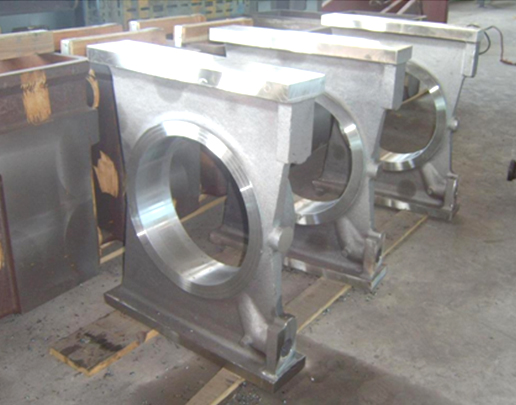
Casting is a widely used molding process in manufacturing, but during the cooling process, castings often experience deformation problems, which seriously affect product quality and production efficiency.
1、 The main reasons for cooling deformation of castings in Dalian
1. Uneven temperature gradient
During the cooling process, the temperature drop rate of each part of the casting is inconsistent, resulting in uneven shrinkage. The thick walled part has slow cooling and large shrinkage; The thin-walled part cools quickly and shrinks less, which leads to stress accumulation and deformation.
2. Material shrinkage characteristics
Metals undergo three types of shrinkage from liquid to solid and then to room temperature: liquid shrinkage, solidification shrinkage, and solid shrinkage. The shrinkage rate of different metals varies, for example, cast iron is about 1%, cast steel is about 2%, and aluminum alloy is about 1.3%.
3. Mold constraints
The constraint effect of molds on castings can lead to uneven shrinkage. When certain parts of the mold hinder the shrinkage of the casting significantly, internal stress will be generated, and plastic deformation will occur when the stress exceeds the yield strength of the material.
4. Residual stress
If the thermal stress and phase transition stress formed during the cooling process cannot be completely released, they will exist in the form of residual stress in the casting, leading to deformation during subsequent processing or use.
2、 Technical measures to solve the cooling deformation of castings
1. Optimize casting process design
(1) Reasonable pouring system design: using multiple gates and dispersed pouring methods to evenly fill the mold cavity with molten metal and reduce temperature gradients.
(2) Set up risers and cold iron: Set up risers to compensate for shrinkage in thick areas, and place cold iron in thin-walled areas to accelerate cooling and balance the cooling rate.
(3) Appropriate casting inclination: Add an appropriate draft angle (usually 1-3 °) in mold design to reduce demolding resistance.
2. Control the cooling process
(1) Segmented cooling control: Adopting a cooling strategy of fast first and then slow, rapid cooling during the high temperature stage avoids coarse grains, and slow cooling during the low temperature stage reduces stress.
(2) Uniform cooling environment: To ensure that all parts of the casting are under the same cooling conditions during the cooling process, rotational cooling or forced convection can be used.
(3) Control unboxing time: The casting should be kept in the mold for sufficient time to complete most of the shrinkage before unboxing, usually 2-3 times the solidification time at the thick part of the casting.
3. Material and mold optimization
(1) Select low shrinkage alloys: Choose casting alloys with lower shrinkage rates while meeting performance requirements.
(2) Mold material selection: Use mold materials with thermal conductivity that match the casting material, such as sand molds commonly used for cast iron parts and metal molds commonly used for aluminum alloys.
(3) Mold preheating: Preheat the mold to an appropriate temperature (usually 150-300 ℃) to reduce the initial cooling rate difference.
4. Subsequent processing techniques
(1) Aging treatment: Natural aging (3-6 months) or artificial aging (heating to 150-300 ℃ for insulation and slow cooling) is performed on the castings to eliminate residual stress.
(2) Mechanical correction: For deformed castings, use a press or local heating correction, but be careful to avoid introducing new stresses.
(3) Heat treatment shaping: Re heat the deformed casting to a plastic state (50-100 ℃ below the solidus line) and press it in the mold for shaping.
3、 Advanced technology application
1. Numerical simulation technology
Using casting simulation software such as ProCAST and MAGMA to simulate the cooling process, predict deformation trends, and optimize process parameters.
2. Intelligent control system
Install temperature sensors at the cooling station to monitor the temperature field of the castings in real-time and adjust the cooling intensity through feedback control.
3. Additive manufacturing technology
For complex castings, 3D printed sand molds or investment molds can be used to achieve more accurate cooling system design.
4、 Quality Management and Prevention
Establish a comprehensive process specification and strictly control the parameters of each link.
Regularly inspect the size and condition of molds, and promptly repair or replace worn molds.
Perform full-scale inspection on the first item, confirm no deformation issues, and then proceed with mass production.
Establish a casting deformation database and accumulate experience data for process optimization.
The cooling deformation of castings is a complex problem influenced by multiple factors, which requires comprehensive consideration from multiple aspects such as design, materials, processes, and molds. By optimizing the cooling process control, adopting advanced technology and strict quality management, it is possible to effectively reduce or even eliminate casting deformation problems, improve product quality and production efficiency. With the development of intelligent manufacturing technology, casting deformation control will become more precise and efficient.