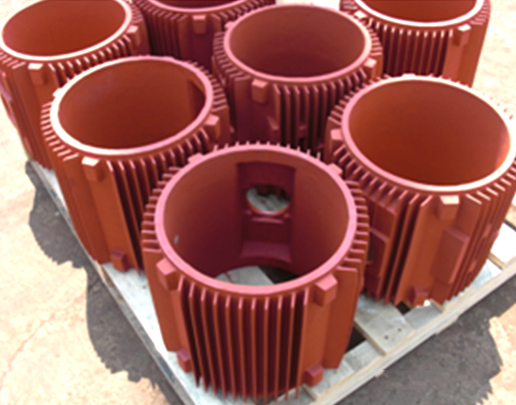
As the core power equipment in industrial production, the normal operation of motors is crucial for production efficiency and equipment lifespan. The high temperature of Dalian motor casing is a common but not negligible problem, which may lead to aging of insulation materials, decreased efficiency, and even equipment damage.
1、 Excessive temperature of motor casing caused by electrical factors
1. Abnormal voltage
High or low voltage can cause the motor to heat up. When the voltage exceeds the rated value, the magnetic flux density of the iron core increases, leading to an increase in iron loss; If the voltage is too low, the current will increase to meet the load demand, resulting in increased copper loss. Both of these situations will cause the motor temperature to rise.
Solution: Install a voltage regulator to ensure that the supply voltage fluctuates within ± 5% of the rated value. Regularly check the voltage of the power grid and adjust the transformer tap changer if necessary.
2. Current imbalance
Unbalanced three-phase current can cause additional heating, and even if the average current is within the rated range, the unbalanced current will generate a negative sequence magnetic field, inducing eddy currents in the rotor and causing local overheating.
Solution: Use a clamp ammeter to regularly measure the three-phase current, and the imbalance should be controlled within 10%. Check if the power wiring is loose and if the load distribution is balanced.
3. Winding fault
Winding short circuit, grounding or turn to turn short circuit can cause an increase in local current density and generate a large amount of heat. Insulation aging, mechanical damage, or overvoltage impact can all lead to winding failure.
Solution: Regularly conduct insulation resistance testing and DC resistance measurement. If a winding fault is found, it should be repaired or replaced in a timely manner. For important motors, winding temperature monitoring devices can be installed.
2、 Excessive temperature of motor casing caused by mechanical factors
1. Bearing malfunction
Lack of oil in bearings, deterioration of lubricating grease, bearing wear or improper installation can increase friction, leading to increased mechanical losses, and heat is conducted to the motor housing through the shaft.
Solution: Lubricate according to the manufacturer's recommended cycle and grease type. Monitor the sound of bearing operation and regularly measure vibration values. Ensure installation accuracy when replacing bearings.
2. Excessive mechanical load
Overloading of the motor will cause the current to exceed the rated value, and the copper loss will increase proportionally to the square of the current, leading to a rapid rise in temperature. Mechanical faults such as jamming and increased resistance in the transmission system can also be reflected as motor overload.
Solution: Check if the load exceeds the motor capacity and replace with a higher power motor if necessary. Check if the transmission system is flexible and eliminate mechanical blockages.
3. Unbalanced rotor
Poor rotor dynamic balance can generate additional vibration, which not only increases bearing load but also generates eddy current losses inside the motor.
Solution: Perform dynamic balance correction on the rotor of the high-speed motor. Check the rotor for deformation, loose components, or foreign object attachment.
3、 High temperature caused by issues with the cooling system
1. Cooling system malfunction
For forced air cooling motors, fan damage, air duct blockage, or cooling fan failure can all reduce heat dissipation efficiency. Water cooled motors may experience water blockage, water pump failure, or insufficient cooling water flow.
Solution: Regularly clean the dust on the air ducts and heat sinks. Check if the fan direction is correct and if the blades are intact. The water cooling system should monitor water pressure, flow rate, and water temperature.
2. The ambient temperature is too high
The motor is installed in a high-temperature environment or enclosed space, and when the ambient air temperature exceeds 40 ℃, the heat dissipation conditions deteriorate, resulting in the shell temperature exceeding the standard.
Solution: Improve the ventilation conditions of the motor installation site and add forced ventilation facilities if necessary. Avoid direct sunlight and use motors with higher insulation levels in high-temperature environments.
3. Accumulation of dirt on the outer shell
The accumulation of dust, oil stains, etc. on the surface of the motor casing can form a thermal insulation layer, which seriously affects the heat dissipation effect.
Solution: Establish a regular cleaning system to keep the motor casing clean. Fully enclosed motors can be considered for use in dusty environments.
4、 Excessive temperature caused by improper design and selection
1. Improper selection of motor power
The mismatch between the motor power and the actual load can lead to low efficiency, and the power factor difference during partial load operation can also generate additional heat.
Solution: Choose the appropriate motor power based on the actual load characteristics to avoid excessive design. For variable load scenarios, variable frequency speed regulation can be considered.
2. Improper startup method
Directly starting a high-power motor will generate 5-7 times the rated current. Frequent starting causes the winding to repeatedly withstand high current shocks and accumulate heat.
Solution: Use soft starters or frequency converters to start high-power motors. Limit the number of startups per hour and extend the startup interval for overloaded startups.
3. Inconsistent insulation level
Using low insulation level motors in high-temperature environments, or motor insulation aging leading to a decrease in temperature resistance.
Solution: Choose a motor with an appropriate insulation level based on the ambient temperature. Regularly check the insulation condition, and F-class insulated motors can extend their lifespan when used under B-class temperature rise.
5、 Other special reasons
1. Harmonic effects
The harmonics generated by the frequency converter power supply can cause additional iron and copper losses, especially high-frequency harmonics that produce significant eddy current losses in the rotor.
Solution: Install dv/dt filter or sine wave filter at the output end of the frequency converter. Choose a motor specifically designed for variable frequency drives.
2. Frequent start stop or forward/reverse rotation
Frequent operation can keep the motor in a starting current state for a long time, accelerating the temperature rise.
Solution: Optimize the process flow and reduce unnecessary operations. If necessary, choose higher grade motors or increase external cooling.
3. Basic installation issues
An unstable or poorly aligned motor installation foundation can lead to increased vibration and the conversion of mechanical energy into thermal energy.
Solution: Ensure that the installation foundation is solid and flat, and use a laser alignment instrument to calibrate the coupling alignment accuracy.
6、 Comprehensive treatment strategy for high temperature
When the temperature of the motor casing is found to be too high, a systematic diagnostic method should be adopted:
Measurement record: Use an infrared thermometer to record the temperature distribution of various parts of the shell and identify hotspots
Current detection: measure the magnitude and balance of three-phase current
Vibration analysis: detecting bearing and mechanical vibration conditions
Insulation test: evaluate the insulation condition of the winding
Environmental assessment: Check cooling conditions and ambient temperature
The preventive maintenance plan should include regular lubrication, cleaning, electrical testing, and mechanical inspection. For critical equipment, it is recommended to install an online temperature monitoring system to achieve early warning.