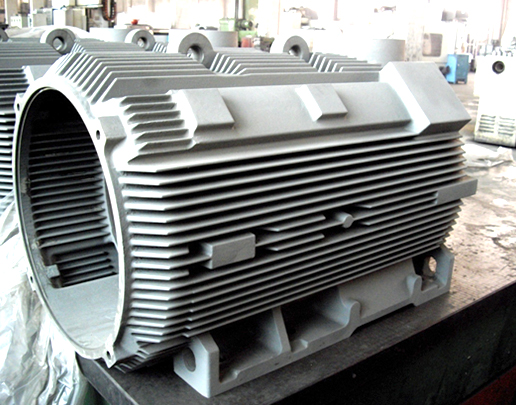
As the core power equipment of modern industry, electric motors are widely used in fields such as automobiles, home appliances, industrial automation, aerospace, etc. As an important component of the motor, the Dalian motor casing not only plays a role in protecting the internal structure, but also directly affects the assembly accuracy, operational stability, and service life of the motor. Therefore, controlling the dimensional tolerance of the motor casing is crucial.
1. The relationship between the function of the motor casing and tolerance control
The main functions of the motor casing include:
Structural support: Fix core components such as stator and rotor to ensure the stability of the overall structure of the motor.
Heat dissipation and protection: Optimize heat dissipation performance through shell design and prevent external factors such as dust and moisture from affecting motor operation.
Electromagnetic shielding: Some motor casings need to have electromagnetic shielding function to reduce electromagnetic interference (EMI).
Assembly accuracy: Ensure precise fit of components such as bearings and end caps, reducing vibration and noise.
If the dimensional tolerance control of the motor housing is improper, it may lead to the following problems:
Assembly difficulties: Excessive dimensional deviations can cause components such as bearings and end caps to be unable to be installed smoothly, and may even require rework or scrapping.
Unstable operation: Excessive tolerance may cause bearing eccentric wear, uneven air gap, resulting in motor vibration, increased noise, and even affecting lifespan.
Poor heat dissipation: Poor coordination between the casing and the heat sink or cooling system may lead to a decrease in heat dissipation efficiency and affect motor performance.
Therefore, strict dimensional tolerance control is the key to ensuring the normal functioning of the motor casing.
2. The impact of dimensional tolerances on motor performance
(1) The impact on assembly accuracy
The dimensional tolerance of the motor casing directly affects the assembly accuracy of the bearings, stator, and rotor. For example:
Tolerance of bearing seat hole: If the diameter or roundness of the bearing seat hole exceeds the tolerance, it may cause the bearing to deviate after installation, increase friction, and reduce bearing life.
End cap fit tolerance: The tight or loose fit between the end cap and the motor housing can affect the sealing performance, which may cause lubricant leakage or external contaminants to enter.
(2) The impact on the stability of motor operation
When the motor is running at high speed, small dimensional deviations may cause:
Uneven air gap: Uneven air gap between stator and rotor can cause electromagnetic force imbalance, resulting in vibration and noise.
Dynamic balance problem: If the machining accuracy of the motor housing is insufficient, it may lead to poor rotor dynamic balance, affecting the high-speed operation stability of the motor.
(3) The impact on heat dissipation performance
During the operation of the motor, a large amount of heat is generated. If the fitting tolerance between the housing and the heat sink or cooling system is too large, it may lead to:
Poor contact: The heat sink is not tightly attached to the housing, which reduces the thermal conductivity efficiency.
Poor air duct: Some motors use forced air cooling. If the size deviation of the air duct is too large, it may affect the airflow distribution and cause local overheating.
3. Manufacturing process and tolerance control
The manufacturing of motor casing usually involves casting, machining, welding and other processes, and different processes have different requirements for tolerance control:
(1) Casting process
Sand casting: suitable for large-scale production, but with low dimensional accuracy, usually requiring subsequent machining correction.
Die casting: High precision, suitable for complex shaped motor housings, but high cost.
(2) Machining process
Turning and milling: used to improve the accuracy of key mating surfaces, such as bearing seat holes, end cap mounting surfaces, etc.
Grinding: Used for high-precision surface treatment to ensure dimensional tolerances are within ± 0.01mm.
(3) Welding process
Welding deformation may lead to dimensional deviations, which require subsequent correction or precision machining to ensure accuracy.
In order to ensure that the dimensional tolerance of the motor housing meets the requirements, high-precision measuring equipment (such as coordinate measuring machines, laser scanners) should be used for inspection during the manufacturing process, and quality monitoring should be carried out in combination with statistical process control (SPC) methods.
4. Industry standards and tolerance requirements
Different industries have different tolerance requirements for motor casings, for example:
Automotive motor: requires high precision (IT6-IT7 tolerance) to ensure stability during high-speed operation.
Industrial motors: usually adopt IT7-IT8 level tolerances, balancing cost and performance.
Home appliance motors: The tolerance requirements are relatively loose (IT8-IT9 levels), but assembly reliability still needs to be ensured.
International standards (such as ISO, DIN) and national standards (such as GB) have clear regulations on the tolerance range of motor housings, and manufacturers must strictly follow them.
The importance of controlling the size tolerance of the motor casing is reflected in multiple aspects:
Ensure assembly accuracy and avoid assembly problems caused by dimensional deviations.
Improve operational stability, reduce vibration, noise, and wear.
Optimize heat dissipation performance to prevent poor heat dissipation caused by excessive tolerances.
Meet industry standards and ensure that products meet quality requirements.
Therefore, in the design, manufacturing, and testing process of the motor housing, it is necessary to strictly control the dimensional tolerances to improve the overall performance and reliability of the motor. In the future, with the development of intelligent manufacturing and precision machining technology, the tolerance control of motor housings will be more precise, further promoting the high-quality development of the motor industry.