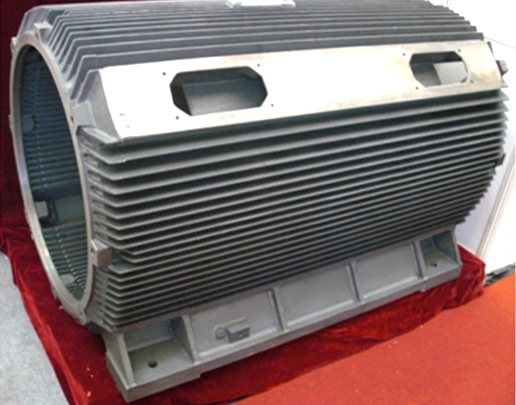
As the core power equipment of modern industry, the performance of Dalian Electric Motor is closely related to the choice of housing type. The motor casing is not only a physical barrier to protect internal components, but also a key factor affecting heat dissipation, protection level, and service life.
1、 The correlation between motor load characteristics and housing selection
1.1 Basic classification of load types
Motor loads can be divided into three categories: constant loads, variable loads, and impulse loads. Stable operating conditions under constant loads such as fans, pumps, etc; Frequent speed regulation is required for variable loads such as machine tools, conveyor belts, etc; There is an instantaneous high torque demand for impact loads such as stamping machines, crushers, etc. Different loads have varying requirements for the mechanical strength and heat dissipation performance of the motor casing.
1.2 Load cycle and shell durability
The continuous working system (S1) load requires the shell to have continuous heat dissipation capability, usually choosing a cast iron shell with heat dissipation ribs; Short term work schedule (S2) can consider more economical aluminum shells; The intermittent cycle working system (S3-S8) requires attention to the fatigue resistance characteristics of the shell material to avoid cracking caused by thermal cycling.
1.3 Analysis of Load Torque Characteristics
Constant torque load (such as winch) requires uniform heat dissipation of the shell structure; Square torque loads (such as centrifugal pumps) generate less heat at low speeds, simplifying heat dissipation design; High speed sections with constant power loads (such as machine tool spindles) require enhanced heat dissipation capabilities of the casing. The application scenarios with large torque fluctuations also need to consider the vibration damping characteristics of the shell.
2、 Mainstream motor housing types and their load adaptability
2.1 Cast iron casing (IP54/IP55)
The gray cast iron (HT250) shell has excellent shock absorption and thermal stability, and is suitable for:
Overloaded starting crushing equipment
Ball mill with high inertia load
Corrosive environment in the chemical industry
A typical wall thickness of 12-20mm can improve heat dissipation efficiency by 15-20% by adding heat dissipation ribs (spaced 40-60mm apart). But a heavier weight will increase installation costs.
2.2 Aluminum casing (IP23/IP54)
The advantages of die-casting aluminum alloy (ADC12) shell are:
Weight reduced by over 40%, suitable for mobile devices
The heat dissipation coefficient is twice that of cast iron, suitable for high-power density applications such as servo motors
After surface oxidation treatment, it can withstand salt spray environment
The disadvantage is that the mechanical strength is low and it is not suitable for situations where the impact load exceeds 150% of the rated value.
2.3 Steel plate welded shell (IP55/IP56)
Made by welding Q235B steel plate (3-5mm), the characteristics include:
Excellent impact resistance, suitable for mining machinery
Modular design facilitates maintenance and allows for the establishment of maintenance windows
Electromagnetic shielding achieved through a double-layer clamp structure
Attention should be paid to welding deformation control, usually requiring a flatness of ≤ 0.1mm/100mm.
2.4 Engineering plastic shell (IP65/IP67)
PPS+30% GF and other composite materials are suitable for:
The food and pharmaceutical industry requires acid and alkali washing resistance
Light load servo system (load rate<60%)
Robot joints sensitive to weight
The working temperature range is -30 ℃~120 ℃, but long-term high temperature environment can cause material creep.
3、 Quantitative matching of load parameters and shell selection
3.1 Heat load calculation model
According to the IEC60034 standard, the heat dissipation capacity of the shell should meet the following requirements: Q=(1- η) P/η ≥ k · A ·Δ T, where η is efficiency, P is input power, k is heat dissipation coefficient (about 15W/m ² K for cast iron), A is effective heat dissipation area, and Δ T is allowable temperature rise. For example, a 22kW motor (η=91%) requires at least 0.8m ² of heat dissipation area in a 40 ℃ environment.
3.2 Mechanical strength verification
The deformation resistance of the shell needs to be verified for impact load: σ=M/W ≤ [σ] M is the impact torque (N · m), W is the section coefficient (cm ³), and the allowable stress of cast iron [σ] ≈ 80MPa. For an instantaneous impact of 10kN · m, it is required that the thickness of the shell flange be no less than 25mm.
3.3 Vibration frequency avoidance
When the load excitation frequency approaches the natural frequency of the shell, the structure needs to be adjusted: fn=(1/2 π) √ (k/m). By adding reinforcement bars (stiffness k increased by 30-50%) or using damping materials (such as cast iron lined with rubber), the resonance risk can be reduced by more than 60%.
4、 Optimization scheme for shell under special load conditions
4.1 High frequency variable frequency load
Axis current problem caused by PWM power supply, suggestions:
Using insulation coating with conductivity<0.1 μ S/cm
Install grounding carbon brushes in the bearing chamber
Add μ - metal electromagnetic shielding layer to the shell
4.2 Corrosive Environmental Load
Recommended motors for chemical pumps:
Cast iron shell sprayed with PTFE coating (acid and alkali resistant pH 1-14)
Stainless steel fasteners (A4-80 grade)
Fully sealed structure combined with breathing valve
4.3 High altitude applications
When the altitude exceeds 1000m:
The heat dissipation area needs to be increased (1% increase for every 100m increase)
Select UV resistant PC material for observation window
The junction box adopts a pressure balanced design
5、 Selection Decision Process and Case Analysis
5.1 Systematic selection steps
Record the load curve (including torque during start-up, operation, and braking stages)
Calculate equivalent heat load (RMS value)
Determine the protection level (according to IEC60529)
Select materials (considering cost, weight, and corrosion factors)
Validate structural strength (FEA analysis)
Develop maintenance plans (such as oil inlet design for oil lubricated bearings)
5.2 Comparison of Typical Cases
Textile machinery (24-hour continuous operation):
Wrong selection: Aluminum shell IP54 → Excessive temperature rise leads to insulation aging
Correct solution: Cast iron shell IP55 with axial ventilation duct, measured temperature rise reduced by 22 ℃
Port crane (frequent start stop):
Original configuration: Standard cast iron shell → Weld seam cracking after 3 years
Optimized: Steel plate welded shell+rubber shock absorber pad, extended lifespan to 8 years
The selection of motor casing requires comprehensive consideration of load characteristics, environmental conditions, and economic factors. With the development of simulation technology and new materials, the future motor housing will achieve a higher degree of load adaptability, providing more reliable power support for various industrial applications.