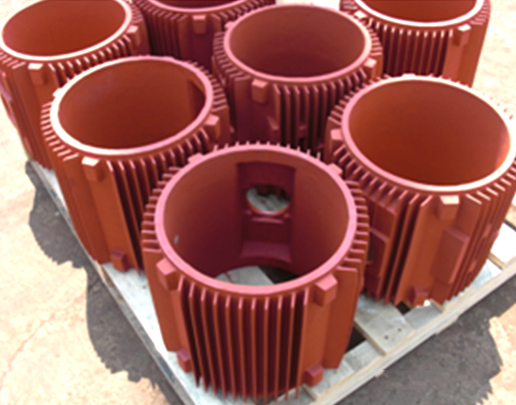
As an important component of the motor, the lightweight design of the Dalian motor housing not only improves the overall performance of the motor, but also reduces energy consumption, material usage, and manufacturing costs. In recent years, with the rapid development of new energy vehicles, aerospace, industrial automation and other fields, the demand for lightweight motor housings has become increasingly urgent. The following discusses the breakthroughs in lightweight technology for motor casings from three aspects: materials, processes, and structural design.
1、 Material Innovation: Application of Lightweight and High Strength Materials
Materials are the foundation of lightweighting for motor casings. Traditional motor casings often use cast iron or aluminum alloys, but in recent years, the application of new materials has provided more possibilities for lightweighting.
High-strength aluminum alloy
Aluminum alloy has become the main material for lightweight motor casings due to its low density, good corrosion resistance, and ease of processing. By optimizing the composition of aluminum alloys (such as adding elements such as silicon and magnesium) and heat treatment processes, their strength and heat resistance can be further improved to meet the needs of motor casings under high temperature and high load conditions.
magnesium alloy
The density of magnesium alloy is only 2/3 of that of aluminum alloy, making it an ideal choice for lightweight materials. However, the low corrosion resistance and strength of magnesium alloys limit their widespread application. In recent years, the performance of magnesium alloys has been significantly improved through surface treatment techniques such as micro arc oxidation, chemical plating, and alloying modification, and has gradually been applied in the manufacturing of high-end motor casings.
composite material
Carbon fiber reinforced polymer (CFRP) and glass fiber reinforced polymer (GFRP) have the characteristics of high specific strength and low density, showing great potential in lightweighting of motor casings. For example, carbon fiber composite motor housings are not only lightweight, but also effectively reduce electromagnetic interference. At present, the cost of composite materials is relatively high, but with the advancement of manufacturing processes, their application scope is expanding.
Foam metal material
Foam metal materials such as foam aluminum and foam magnesium have porous structure, low density and excellent energy absorption performance, which are suitable for motor housings with high requirements for weight reduction and shock absorption. By combining foam metal with high-strength materials, the performance of motor housing can be further optimized.
2、 Manufacturing process: Advanced molding and processing technology
The advancement of manufacturing technology has provided technical support for the lightweighting of motor casings. Here are some key process breakthroughs.
Precision Casting Technology
Precision casting (such as die-casting and low-pressure casting) can produce motor housings with complex shapes and uniform wall thickness, reducing material waste. By optimizing mold design and process parameters, the strength and accuracy of castings can be further improved.
Additive Manufacturing (3D Printing)
3D printing technology can achieve rapid prototyping of complex structures, providing more possibilities for lightweight design of motor casings. For example, through topology optimization design, material usage can be reduced while ensuring strength. In addition, 3D printing can also achieve integrated manufacturing of multiple materials, further improving the performance of motor casings.
Hydraulic Forming and Stamping Forming
Hydraulic forming and stamping forming technologies can manufacture thin-walled, high-strength motor casings, suitable for mass production. By optimizing the molding process and mold design, the molding accuracy and material utilization can be further improved.
Surface strengthening technology
Through surface treatment techniques such as spraying, electroplating, laser cladding, etc., the wear resistance, corrosion resistance, and heat resistance of the motor casing can be enhanced, thereby reducing material thickness and achieving lightweight.
3、 Structural Design: Optimization and Innovation
Structural design is the core of lightweighting the motor casing, and weight reduction can be achieved through optimized design while ensuring performance.
topology
Topology optimization is a design method based on finite element analysis, which calculates the optimal distribution of materials, removes redundant parts, and achieves lightweight design. For example, designing weight reducing holes or reinforcing ribs in non critical parts of the motor casing can reduce material usage without affecting strength.
Thin walled design
By optimizing the wall thickness distribution of the motor casing, weight reduction can be achieved while ensuring stiffness and strength. For example, by adopting a variable wall thickness design, the thickness can be increased in areas with higher stress and reduced in areas with lower stress.
integrated design
Integrating the motor casing with other components such as heat sinks, mounting brackets, etc. can reduce the number of parts and the use of connectors, thereby reducing the overall weight. For example, using an integrated casting process, the motor casing and heat dissipation structure are integrated together.
Bionics Design
Biomimetic design draws inspiration from lightweight and high-strength structures in nature, such as honeycomb and skeletal structures, providing new ideas for the lightweighting of motor casings. For example, the motor housing with honeycomb structure is not only lightweight, but also has excellent compressive and impact resistance performance.
The lightweighting of motor casings is a multidisciplinary field that involves collaborative innovation in materials, processes, and design. With the continuous breakthroughs in new materials, processes, and technologies, the lightweighting of motor housings will develop towards greater efficiency, environmental friendliness, and intelligence, providing strong support for the transformation and upgrading of the motor industry.