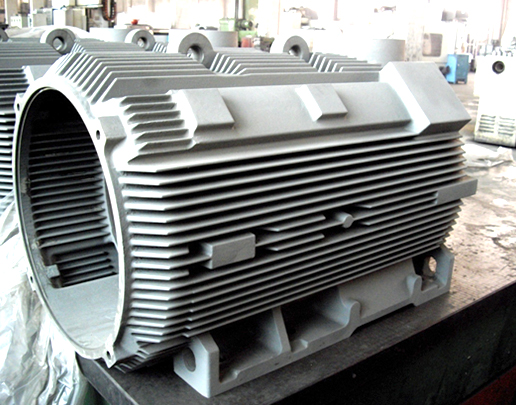
As an important equipment in modern industry, the stability and service life of motors are closely related to their heat dissipation effect. During the operation of the motor, a large amount of heat is generated. If the heat is not dissipated in a timely manner, it can cause the temperature of the motor to rise, thereby affecting its working efficiency and even causing malfunctions. The material selection of the Dalian motor casing, as the external structure of the motor, has a significant impact on the heat dissipation effect.
thermal conductance
Thermal conductivity is an important indicator for measuring the ability of materials to transfer heat. The thermal conductivity of the motor housing material directly affects the efficiency of heat dissipation inside the motor. Common materials for motor casings include aluminum alloy, cast iron, stainless steel, and plastic.
Aluminum alloy: Aluminum alloy is one of the commonly used materials for motor casings, with good thermal conductivity, usually between 120-220W/(m · K). Aluminum alloy motor casing can quickly conduct the heat generated inside the motor to the outside, and dissipate the heat through air convection or heat dissipation fins, effectively reducing the operating temperature of the motor. In addition, aluminum alloy is lighter in weight, which helps to reduce the overall weight of the motor.
Cast iron: The thermal conductivity of cast iron is relatively low, generally between 40-50W/(m · K). Although cast iron motor casings have higher mechanical strength, their heat dissipation effect is not as good as aluminum alloys. Therefore, cast iron motor casings are usually used in situations where heat dissipation requirements are not high, or to compensate for their insufficient thermal conductivity by adding heat dissipation fins and other methods.
Stainless steel: Stainless steel has poor thermal conductivity, usually between 15-20W/(m · K). The heat dissipation effect of stainless steel motor casing is not as good as that of aluminum alloy and cast iron, but its corrosion resistance and mechanical strength are higher, making it suitable for motors in harsh environments.
Plastic: The thermal conductivity of plastic is low, generally between 0.1-0.5W/(m · K). The heat dissipation effect of plastic motor shells is poor, but they are lightweight and low-cost, and are commonly used in small motors or situations where heat dissipation requirements are not high.
mechanical strength
The motor casing not only needs to have good heat dissipation performance, but also needs to have sufficient mechanical strength to protect the internal components of the motor from external impacts and vibrations.
Aluminum alloy: Aluminum alloy has moderate mechanical strength and can meet the needs of most motors. But its hardness is low and it is easily damaged by external impacts.
Cast iron: Cast iron has high mechanical strength and can effectively protect the internal components of the motor. But its weight is relatively large, which increases the overall weight of the motor.
Stainless steel: Stainless steel has high mechanical strength and good corrosion resistance, making it suitable for motors in harsh environments. But its cost is high and its weight is also large.
Plastic: Plastic has low mechanical strength and is easily damaged by external impacts. But it is lightweight, low-cost, and suitable for small motors.
corrosion resistance
The corrosion resistance of the motor housing material directly affects the service life of the motor, especially in humid, corrosive gas or liquid environments.
Aluminum alloy: Aluminum alloy has good corrosion resistance, but in some corrosive environments, surface treatment such as anodizing is still needed to improve its corrosion resistance.
Cast iron: Cast iron has poor corrosion resistance and is prone to rusting. Therefore, cast iron motor casings usually require surface treatment such as painting or galvanizing to improve their corrosion resistance.
Stainless steel: Stainless steel has good corrosion resistance and can resist most corrosive media. Therefore, stainless steel motor housings are suitable for motors in harsh environments.
Plastic: Plastic has good corrosion resistance and can resist most corrosive media. But its mechanical strength is low and it is easily damaged by external impacts.
cost
The selection of motor casing material also needs to consider cost factors. The cost difference of different materials is significant, which directly affects the overall cost of the motor.
Aluminum alloy: The cost of aluminum alloy is moderate and can meet the usage needs of most motors.
Cast iron: Cast iron has a lower cost, but its weight is larger, which increases the overall cost of the motor.
Stainless steel: Stainless steel has a higher cost, but its corrosion resistance and mechanical strength are good, making it suitable for motors in harsh environments.
Plastic: Plastic has the lowest cost, but its mechanical strength is low and its heat dissipation effect is poor.
Other factors
In addition to the above factors, the selection of motor housing material also needs to consider other factors, such as processing difficulty, aesthetic appearance, etc.
Aluminum alloy: The processing difficulty of aluminum alloy is moderate, which can meet the processing needs of most motors. Its appearance is aesthetically pleasing and suitable for occasions where there are requirements for the appearance of the motor.
Cast iron: The processing difficulty of cast iron is relatively high, but its mechanical strength is good, suitable for occasions that require mechanical strength.
Stainless steel: Stainless steel is difficult to process, but it has good corrosion resistance and mechanical strength, making it suitable for motors in harsh environments.
Plastic: The processing difficulty of plastic is relatively low, but its mechanical strength is low and its heat dissipation effect is poor.
The material of the motor casing has a significant impact on the heat dissipation effect. Aluminum alloy motor casing has become the main material of choice for most motors due to its good thermal conductivity, moderate mechanical strength, and low cost. Cast iron motor casing is suitable for applications with low heat dissipation requirements due to its high mechanical strength and low cost. Stainless steel motor casing is suitable for motors in harsh environments due to its excellent corrosion resistance and mechanical strength. Plastic motor housings are suitable for small motors or situations with low heat dissipation requirements due to their lower cost and weight. In practical applications, it is necessary to comprehensively consider factors such as thermal conductivity, mechanical strength, corrosion resistance, and cost based on the specific usage environment and requirements of the motor, and select the appropriate motor housing material to ensure stable operation and extend the service life of the motor.