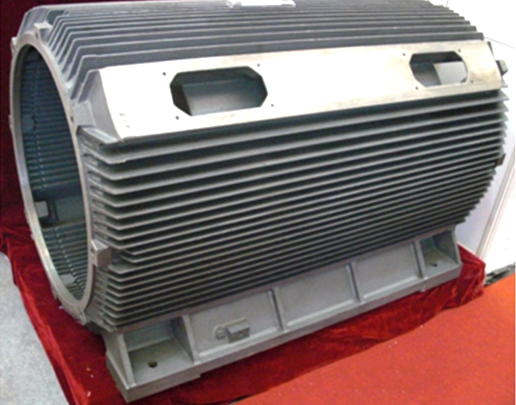
Optimization and Improvement Solutions for Poor Heat Dissipation of Dalian Motor Casings.
As the core pathway for transferring internal heat from the motor to the outside, the heat dissipation efficiency of the motor casing directly affects the motor's operational stability, lifespan, and energy efficiency. Dalian's hot and humid summer climate further amplifies the risks associated with poor heat dissipation (such as winding overheating burnout and accelerated insulation aging). To address motor casing heat dissipation issues, systematic optimization is required from multiple dimensions including material selection, structural design, surface treatment, installation processes, and auxiliary cooling. The specific improvement solutions are as follows:
I. Material Optimization: Enhancing Basic Thermal Conductivity
Common motor casing materials include cast iron (thermal conductivity ≈ 40W/(m·K)) and cast aluminum (≈ 160W/(m·K)), but cast iron has high thermal resistance while cast aluminum lacks density. Optimization directions:
1. Use die-cast aluminum instead of traditional cast aluminum: Die-cast aluminum is formed under high pressure, resulting in a denser internal structure, increasing thermal conductivity to over 200W/(m·K) while providing higher strength, suitable for high-power motors.
2. Locally enhance thermal conductivity materials: Embed copper heat-conducting blocks (thermal conductivity 400W/(m·K)) in the contact area between the stator and casing to shorten the heat transfer path.
3. Explore composite thermal materials: For applications with high lightweight requirements, aluminum-based silicon carbide composites (thermal conductivity 250-350W/(m·K)) can be used, balancing weight and heat dissipation, though cost considerations are needed.
II. Structural Design: Enhancing Convection and Radiation Heat Dissipation
Reasonable casing structure is key to improving heat dissipation efficiency, requiring optimization of cooling fins, ventilation paths, and wall thickness:
1. Cooling fin optimization:
◦ Increase fin height and quantity: Where installation space permits, increase fin height from 20mm to 30-40mm, with spacing控制在15-20mm to avoid obstructing airflow.
◦ Use angled or spiral fins: Replace traditional straight fins to guide airflow along the fin direction, enhancing forced convection effects.
◦ Locally densify fins: Increase fin density in areas corresponding to the stator core (hotspot locations) to target temperature reduction.
2. Ventilation path design:
◦ Axial ventilation holes: Design ventilation holes at both ends of the casing,配合internal fan to form axial airflow circulation.
◦ Radial ventilation slots: Create radial slots on the casing side walls to allow external cold air to directly contact heating areas, especially suitable for enclosed motors.
3. Wall thickness optimization: Balance strength and thermal conductivity, generally控制在5-8mm (too thick increases thermal resistance, too thin affects structural stability).
III. Surface Treatment: Improving Radiation and Convection Efficiency
The surface condition of the motor casing directly affects radiation heat dissipation and air convection:
1. Roughening treatment: Increase surface roughness through sandblasting or chemical etching to expand the convection heat dissipation area (can improve by 15%-20%).
2. High emissivity coating: Apply black oxide coating or ceramic heat dissipation coating (emissivity ≥ 0.85) to enhance radiation heat dissipation capacity.
3. Anti-corrosion treatment: Given Dalian's high humidity, use anodizing or electrophoretic coating to prevent thickening of the surface oxide layer (oxide layer has high thermal resistance) while improving durability.
IV. Installation Process: Reducing Contact Thermal Resistance
The contact thermal resistance between the motor and base is a major bottleneck for heat dissipation. Optimization measures:
1. Mounting surface flatness control: Control mounting surface flatness误差within 0.1mm to avoid increased thermal resistance due to gaps.
2. Apply thermal pads: Install silicone thermal pads (thermal conductivity 2-5W/(m·K)) between the motor and base to fill微小gaps and reduce contact thermal resistance.
3. Enhance base heat dissipation: If the base is made of non-metallic material, install aluminum heat dissipation plates in the contact area to transfer heat to the surrounding environment.
V. Internal Heat Transfer Optimization: Unblocking Heat Transfer Paths
Internal motor heat must be efficiently transferred to the casing, requiring optimization of internal structures:
1. Thermal filling between stator and casing: Fill the gap between the stator core and casing with thermal grease (thermal conductivity 1-3W/(m·K)) or thermal potting compound to eliminate air gaps.
2. Improve core lamination process: Use low-loss silicon steel sheets to reduce core heating, while optimizing lamination tightness to reduce internal core thermal resistance.
3. Upgrade winding insulation materials: Use high-temperature resistant insulation materials (e.g., polyimide) to allow higher operating temperatures, indirectly alleviating heat dissipation pressure.
VI. Auxiliary Cooling: Addressing Special Operating Conditions
For high-load or high-temperature environments, additional auxiliary cooling measures are needed:
1. Forced air cooling: Install an axial fan at the rear end of the motor casing, using an air guide to direct冷airflow over the cooling fins, improving heat dissipation efficiency by 30%-50%.
2. Water cooling system: For high-power motors, design spiral water cooling channels inside the casing to带走heat through circulating water (heat exchange efficiency is 5-10 times that of air cooling).
3. Heat pipe cooling: Embed heat pipes in casing hotspot areas to quickly transfer heat to cooling fins, suitable for localized high-temperature issues.
VII. Simulation Verification: Precise Optimization
Use CFD simulation software (e.g., Fluent) to model temperature distribution and airflow field of the motor casing, identify hotspot areas, and adjust cooling fin layout and ventilation hole positions accordingly, avoiding trial-and-error and reducing development costs.
Conclusion
Optimizing motor casing heat dissipation requires a systematic approach integrating materials, structure, processes, and auxiliary measures, balancing cost and performance. Motors in Dalian need special consideration of the hot and humid environment. The recommended combination is die-cast aluminum casing + optimized cooling fins + forced air cooling, while also controlling mounting surface thermal resistance. Through systematic optimization, motor casing surface temperature can be reduced by 15-30°C, significantly improving motor reliability and lifespan.