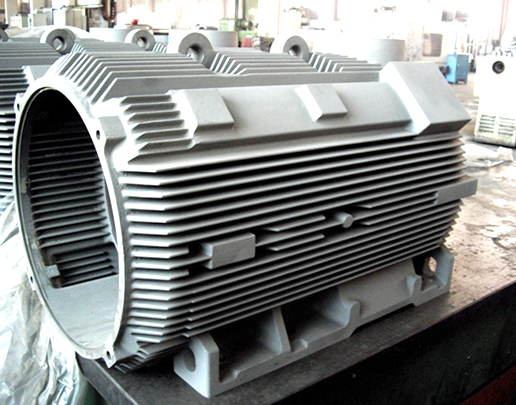
Core Factors for Material Selection of Dalian Motor Housings
As the power core of industrial equipment, new energy vehicles, home appliances and other sectors, a motor housing acts as protection for internal stators, rotors and windings. It also undertakes vital functions including heat dissipation, vibration damping, electromagnetic shielding and structural support. Material selection directly affects service life, efficiency and reliability of motors. Selection shall be made by comprehensively evaluating five core factors instead of merely pursuing superior individual performance.
First, operating environment characteristics, the fundamental prerequisite for material selection. Motors for outdoor construction machinery require resistance to high humidity, salt spray and dust. Aluminum alloy forms a dense oxide film after surface anodization, delivering better rust resistance than cast iron. Motors for coastal wind turbines and chemical pumps demand strong acid and alkali corrosion resistance, making stainless steel (304, 316 grades) an ideal option. Motors operating in low-temperature northern regions need to avoid low-temperature brittleness. Cast iron tends to crack under low-temperature impact, while aluminum alloy features favorable low-temperature toughness for cold-climate applications.
Second, heat dissipation and thermal management requirements. Approximately 20%~30% of electric energy is converted into heat during motor operation, and thermal conductivity of the housing directly determines temperature rise. High-power-density motors such as new energy drive motors require high-thermal-conductivity materials. Aluminum alloy has a thermal conductivity of 160~200W/(m·K), far exceeding the 50~70 of cast iron. It quickly transfers internal heat and prevents winding burnout caused by overheating. Low-power household appliance motors (e.g., indoor air conditioner motors) have low heat dissipation demands, which can be satisfied by glass-fiber-reinforced plastic housings featuring favorable insulation and low cost.
Third, mechanical strength and load-bearing capacity. Heavy-duty large motors such as those for mining crushers withstand huge electromagnetic force and external impacts. Cast iron boasts high rigidity and deformation resistance for heavy-load conditions, yet its weight is 2 to 3 times that of aluminum alloy. Medium-to-high industrial servo motors require a balance of light weight and strength. Alloy-treated 6061-series aluminum alloy achieves strength close to cast iron while greatly reducing overall unit weight. Motors used in food and medical industries need impact resistance and easy cleaning; stainless steel housings combine corrosion resistance and structural strength as the standard industry choice.
Fourth, cost and machinability, key considerations for mass production. Cast iron materials are readily available with mature sand casting processes, costing only 1/3~1/2 of aluminum alloy and suitable for mass production of general industrial motors. Despite higher raw material costs, aluminum alloy supports high-efficiency die casting with excellent surface precision and minimal subsequent machining, leading to controllable overall costs. Stainless steel is difficult to machine, requiring precision welding and surface treatment, and costs 2 to 3 times as much as cast iron, only adopted for special applications. Engineering plastics are easy to process at low cost but have poor heat resistance (generally ≤120°C), only applicable to low-power low-voltage motors.
Fifth, insulation and electromagnetic compatibility requirements. High-voltage and servo motors need mitigation of electromagnetic interference. Metal housings effectively shield external electromagnetic waves and stop internal electromagnetic leakage. Explosion-proof motors and medical sterilization motors require housing insulation to avoid electric hazards; insulating engineering plastics or metal housings with insulating coatings can be adopted.
In summary, material selection for motor housings strikes a balance among application scenarios, performance and cost. Aluminum alloy is adopted for new energy vehicle drive motors to balance heat dissipation and light weight; stainless steel for food processing motors to meet corrosion resistance and hygiene requirements; cast iron for general industrial motors to balance cost and strength. Proper selection enables motors to deliver optimal performance throughout their service life.