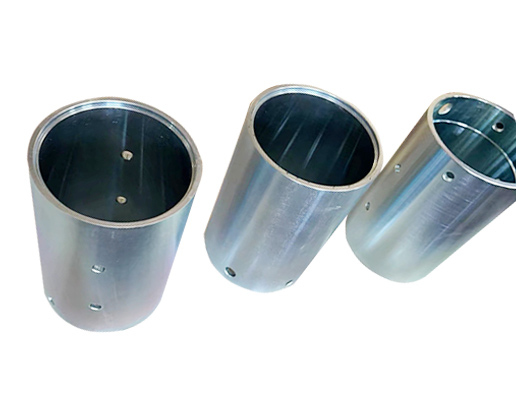
Core Methods for Noise Control of Dalian Motor Housings
Motors serve as core power components in industry, transportation, home appliances and other fields. Their operating noise directly affects user experience and environmental compliance. As the main radiation carrier of vibration and noise, the motor housing accounts for 60%–80% of noise transmission. Noise control for motor housings requires coordinated implementation from four dimensions: structural optimization, material selection, vibration isolation and machining precision, while balancing performance, cost and heat dissipation requirements.
I. Structural Dynamics Optimization: Avoid Resonance Ranges
If the natural frequency of Dalian motor housings coincides with the frequency of internal excitation sources (electromagnetic force waves, bearing rotation, gear meshing, etc.), resonance will occur and amplify noise. Therefore, the core of structural optimization is to match modal characteristics:
Balanced wall thickness design. Higher stiffness does not always come with thicker walls. Finite element analysis is used to adjust wall thickness distribution. Moderate thickening is applied in weakly stressed areas and thinning in redundant regions to achieve lightweight design and balanced stiffness, preventing resonance caused by local stress concentration.
Rational arrangement of reinforcing ribs. Reinforcing ribs are commonly used to improve housing stiffness, yet improper layout may create new resonance modes. Diagonal or cross ribs replace vertical ribs, or segmented ribs are adopted to distribute stiffness and avoid vibration modes corresponding to excitation frequencies. Meanwhile, the number of ribs is reduced to cut weight.
Cross-section configuration optimization. Single circular housings feature concentrated modal distribution. Non-linear cross-sections such as ellipsoid and polygon can adjust overall stiffness distribution and detune resonance ranges, suitable for medium and high-frequency noise control.
II. Composite Material Selection: Improve Damping Performance
A material’s damping capacity determines vibration attenuation efficiency, and damping ratios vary greatly among materials. The damping ratio of gray cast iron is approximately 0.005–0.01, while die-cast aluminum alloy is only 0.001–0.003. Materials shall be selected according to application scenarios:
Cast iron housings are preferred for high-power industrial motors to suppress low-frequency vibration noise via high damping characteristics.
For scenarios requiring lightweight design such as new energy vehicles and home appliances, composite materials are used to boost damping when aluminum housings are adopted. Options include coating high-damping polymer coatings on surfaces (damping ratio over 0.2), or aluminum matrix particle-reinforced composites embedded with ceramic particles to form energy dissipation paths inside the matrix, balancing heat dissipation and noise reduction.
III. Vibration Isolation and Damping Treatment: Cut Off Noise Transmission
The transmission of internal motor vibration to the housing is critical for noise radiation. Multi-dimensional vibration isolation and damping design are required:
Internal vibration isolation. Elastic damping pads (rubber, silicone) are inserted between the stator and inner housing wall to reduce vibration transmissibility and cut internal vibration transmission by more than 80%.
Surface damping layer. Damping paint is coated on the outer housing surface. The material converts vibration energy into thermal energy through internal friction, delivering remarkable effects on high-frequency noise above 2000 Hz.
Double-layer composite housing. For applications with strict noise requirements, the structure of "inner heat-dissipating aluminum shell + outer damping shell" is adopted, with microporous sound-absorbing cotton filled in between. It guarantees motor heat dissipation and blocks acoustic radiation between layers, applicable to certain industrial equipment.
IV. Machining Precision Control: Eliminate Manufacturing Defects
Manufacturing defects greatly increase housing vibration noise. During die casting, pressure and temperature parameters are controlled to reduce internal defects such as pores and shrinkage porosity and ensure uniform housing stiffness. In machining, form and position tolerances of mounting surfaces and rabbets are strictly controlled to guarantee coaxiality of stators and rotors and lower unbalanced assembly vibration. Surface finishing reduces roughness, decreases acoustic radiation resistance and further weakens noise.
In summary, noise control of Dalian motor housings is a multidisciplinary systematic project. Noise, weight, heat dissipation and cost need to be balanced for different scenarios. Low-cost damping materials are prioritized for small household motors, while lightweight composite structures are used for new energy motors to effectively control overall motor noise and meet application standards and user experience.