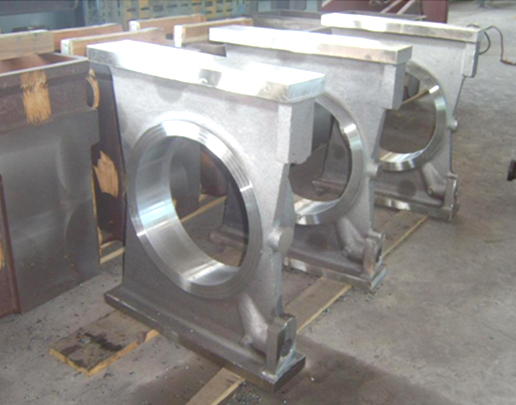
Dalian castings serve as core load-bearing components in mechanical engineering, transportation, energy and other fields. Their mechanical properties directly determine service reliability and service life. Therefore, mechanical property testing is a core link in casting quality control. Centered on key indicators such as strength, plasticity and toughness under stress, mechanical property tests for castings cover mandatory routine items and special items adapted to working conditions. They fully verify casting performance in diverse environments and effectively identify safety risks caused by casting defects.
I. Mandatory Routine Basic Tests
Tensile Test
As the primary static mechanical test, it applies uniaxial loading on standard specimens to measure four key parameters: yield strength (indicating the casting’s resistance to non-permanent deformation and serving as the core basis for structural design), tensile strength (representing ultimate fracture resistance), elongation after fracture and reduction of area (reflecting plastic deformation capacity; castings with insufficient plasticity tend to crack under impact or assembly). The tensile test applies to most castings under static load, such as machine tool beds and agricultural machinery frames. Sampling inspection in mass production ensures consistent performance and indirectly reveals casting microstructure uniformity as well as defects like pores and inclusions.
Hardness Test
Hardness measures a casting’s surface resistance to local deformation. Thanks to simple operation and minor specimen damage, it is widely used for rapid batch screening. Common methods include Brinell hardness (for coarse-grained cast steel and cast iron, reflecting bulk strength), Rockwell hardness (for thin castings or surface hardness detection), and Vickers hardness (for micro-area analysis such as hardness variation near defects). Hardness is closely related to wear resistance; hardness tests can quickly predict service life for wear-resistant castings for mining machinery and automotive gears.
Impact Test
For castings under impact load (e.g., construction machinery buckets, automobile suspensions), the Charpy notch impact test measures impact toughness, i.e., resistance to instantaneous impact fracture. Low-temperature impact tests are required for castings operating in cold environments such as pipelines in frigid zones, to simulate increased material brittleness and prevent low-temperature brittle fracture. Notches on impact specimens amplify the effect of internal defects, so test results indirectly reflect casting quality uniformity.
II. Special Tests for Specific Working Conditions
Fatigue Test
For castings enduring long-term alternating loads (e.g., bridge bearings, engine blocks), cyclic loading is adopted to measure fatigue strength, critical for preventing fatigue fracture. Corrosion fatigue tests are required for some corrosive service environments.
High-temperature Mechanical Test
For castings working at high temperatures (e.g., turbine blades), it includes high-temperature tensile test (measuring high-temperature yield and tensile strength) and creep test (measuring deformation resistance under long-term high-temperature load) to avoid dimensional failure during prolonged high-temperature service.
Bending / Torsion Test
Bending test is used for thin-walled castings and bent pipes to detect bending strength and brittleness and identify internal defects. Torsion test applies to shaft castings such as crane rotary shafts to verify torsion failure resistance.
In summary, the mechanical property testing system for Dalian castings covers multiple scenarios including static/dynamic loads and high/low temperatures. It acts as a core quality control method from raw materials to finished products. Accurate testing eliminates unqualified castings and guarantees safe and stable operation of equipment across various industries.